When shopping for a sofa, you may come across the terms sectional sofa and modular sofa. Many furniture retailers use these terms interchangeably, making it difficult to understand what actually separates the two.
The confusion is understandable. Both sofa types can consist of multiple pieces, offer generous seating, and come in popular configurations such as L-shaped and U-shaped layouts. Some sofas even qualify as both sectional and modular.
The key difference lies in what each term describes. A sectional sofa refers primarily to a seating arrangement made of multiple connected sections, while a modular sofa refers to a seating system built around individual components that can be rearranged into different configurations.
Understanding this distinction can help you choose a sofa that fits your current space, accommodates your household's needs, and offers the right level of flexibility for the future.
What Is a Sectional Sofa?
A sectional sofa is a sofa made up of two or more connected sections that form a larger seating arrangement. Instead of purchasing a single, continuous sofa, you get multiple sections that work together as one piece of furniture.
Common sectional configurations include L-shaped sofas, U-shaped sofas, and sofas with an attached chaise lounge. The arrangement is generally designed to provide ample seating while making efficient use of the available floor space.
Common Types of Sectional Sofas
L-shaped sectional: An L-shaped sectional typically consists of a main sofa section and a perpendicular section that creates a corner. It works well in many living rooms, particularly when you want to define a seating area without placing furniture in the center of the room.

U-shaped sectional: A U-shaped sectional surrounds a central seating area on three sides. It can accommodate larger households or people who frequently entertain guests, although it requires more floor space.

Chaise sectional: This configuration combines a standard sofa section with an extended seat that allows someone to stretch out. Depending on the design, the chaise may be fixed on the left or right side or offered in a reversible arrangement.

Advantages of a Sectional Sofa
One of the main advantages of a sectional sofa is its straightforward layout. When you know how you want to arrange your living room, a sectional provides a coordinated seating solution without requiring you to assemble a configuration from numerous individual pieces.
Sectionals can also make efficient use of corners and create a natural gathering area for family members and guests. Because their overall arrangement is usually established at the time of purchase, it is relatively easy to understand how much space the sofa will occupy.
Potential Limitations
The main limitation is that a sectional's layout may be difficult to change after purchase. Some models have sections that can be detached, but this does not necessarily mean those sections can be rearranged into different configurations.
For example, a sectional designed with a right-facing chaise may not support a left-facing arrangement. Even when the sections separate, their shapes, connection points, or armrest positions may restrict how they can be assembled.
This does not make a sectional a poor choice. It simply means that buyers should check how much flexibility a particular model offers before assuming its layout can change.
What Is a Modular Sofa?
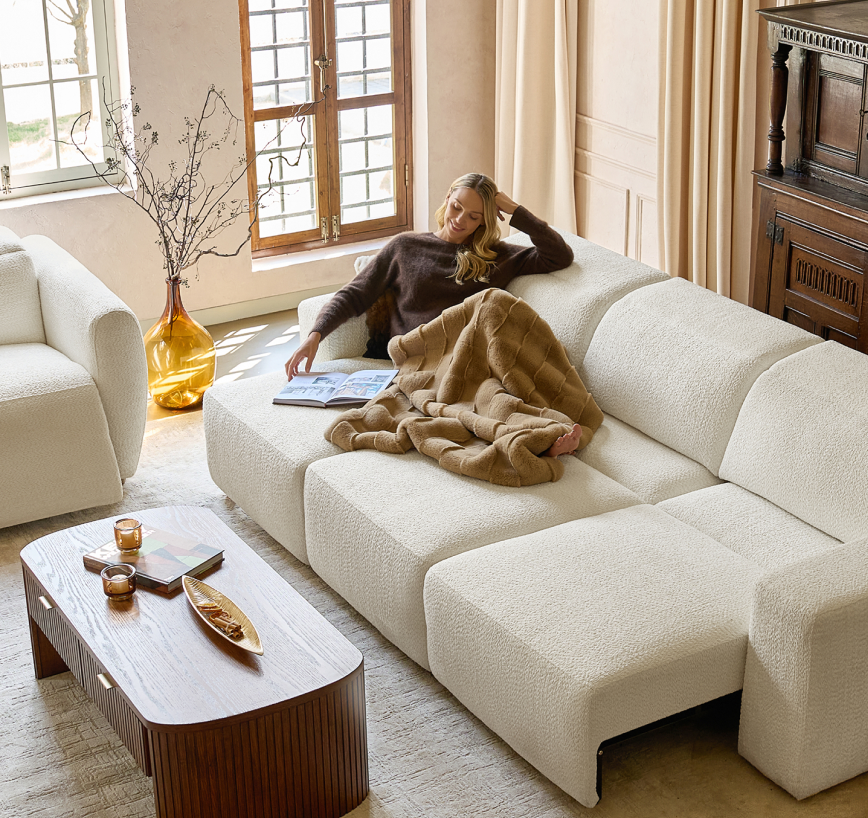
A modular sofa is a seating system made up of individual components, commonly called modules, that are designed to connect in different supported configurations.
These components may include armless seats, corner units, armrest units, chaise modules, and ottomans. Depending on the design, they can be combined, separated, or rearranged to create different seating layouts.
For example, a modular sofa might be arranged as an L-shaped sectional in one room, separated into a straight sofa and an additional seat in another, or expanded with compatible modules to provide more seating.
The defining feature is not simply that the sofa consists of multiple pieces. It is that the components are designed to support alternative configurations.

How Modular Sofas Work
A modular sofa system typically offers a selection of components that connect through designated mechanisms or compatible fittings. The manufacturer determines which combinations are supported, so the available configurations vary between products.
Some systems allow you to change the orientation of the sofa, add seating, or separate components for different uses. Others provide a smaller range of possible arrangements.
It is important to distinguish between a sofa that can be taken apart for delivery and one that is genuinely designed for reconfiguration. A sofa may have detachable sections without offering meaningful flexibility in how those sections can be used.
Advantages of a Modular Sofa
Greater layout flexibility: Modular components can make it easier to adjust a seating arrangement when you move, rearrange your living room, or want to accommodate a different number of people.
Adaptability over time: If your household's needs change, a compatible modular system may allow you to add seats, change the arrangement, or separate components rather than replace the entire sofa.
More options for different spaces: Individual modules can sometimes be arranged to suit different room dimensions or traffic patterns. This can be particularly useful for open-plan living areas or rooms that serve multiple purposes.
Potential Limitations
Modular sofas are not automatically better for every home. Their flexibility depends on the actual components available, how securely they connect, and which configurations the manufacturer supports.
A system may also require more planning than a conventional sectional. You need to determine which modules you need, whether they fit your space, and whether additional components will be available in the future.
If you never intend to change your seating arrangement, paying extra for modular flexibility may offer little practical benefit.
Sectional vs Modular Sofa: What Are the Key Differences?
The most useful way to compare these sofa types is to look beyond their appearance and consider how they are designed to function.
|
Feature |
Sectional Sofa |
Modular Sofa |
|
What the term describes |
A seating arrangement made of connected sections |
A system of individual, configurable components |
|
Typical layout |
Often designed around a particular configuration |
Designed to support multiple configurations |
|
Rearrangement |
Depends on the model; may be limited |
Generally offers more supported layout options |
|
Adding or removing seats |
May require a different model or compatible pieces |
May allow additional or fewer modules |
|
Moving to a new home |
May be challenging if the new room has a different layout |
Can offer more options for adapting to a new space |
|
Best suited for |
People who want a defined seating arrangement |
People who value the ability to reconfigure their seating |
|
Main consideration |
Whether the planned layout fits the room |
Whether the system supports the configurations you need |
These differences describe general tendencies rather than strict rules. Some sectionals have fixed or limited configurations, while others are built from fully reconfigurable modules.
A modular sofa can also be a sectional sofa. For example, a modular system arranged in an L-shape is both modular in its construction and sectional in its layout.
This distinction is important because the terms describe different aspects of the furniture. One tells you how the seating is arranged; the other tells you how the components are designed to work together.
How to Tell Whether a Sofa Is Truly Modular
Product descriptions do not always make the distinction clear. If a retailer describes a sofa as modular, check the following details before making a purchase.
1. Check Whether the Pieces Can Form Different Layouts
Start by looking at the configurations shown on the product page. Can the same set of components form more than one arrangement, or is the sofa simply divided into sections for shipping?
A genuinely reconfigurable system should offer alternative layouts supported by the design. Look for configuration diagrams, assembly instructions, or examples showing the same modules arranged in different ways.
If you want to change an L-shaped sofa into a straight sofa, for example, confirm that the product supports that arrangement rather than assuming it is possible.
2. Check Whether the Chaise Can Change Sides
A reversible chaise can be useful if you might rearrange your living room. However, a chaise that can switch from left to right does not necessarily make the entire sofa modular.
Check whether the chaise is reversible, detachable, or available only in a specific orientation. If changing the chaise position is important to you, confirm exactly how the conversion works.
3. Examine the Connection System
Modular components need to stay securely connected during everyday use. Check how the pieces attach, whether the connectors are designed for repeated rearrangement, and whether the modules remain stable when people sit down or move around.
It is also worth considering how easily the components can be separated when you want to change the layout. Flexibility is useful only if the system is practical to use.
4. Confirm Whether Additional Modules Are Available
Some modular systems allow you to purchase extra seats, corner units, or ottomans later. Others offer only a limited selection of components.
If you expect to expand your sofa in the future, ask whether additional modules are compatible with your original purchase and whether the manufacturer expects to continue offering them.
Do not assume that two modules from the same brand will necessarily connect. Different product lines may use different dimensions, upholstery, or connection systems.
5. Check Replacement and Maintenance Options
A sofa is a long-term household purchase, so consider what happens when a component becomes worn or damaged.
Can individual cushions or covers be replaced? Are compatible replacement components available? Can you repair one section without replacing the entire seating arrangement?
These questions matter for both sectional and modular sofas. A modular design may offer more options for replacing individual pieces, but that advantage depends on the manufacturer's actual support and product availability.

Which Sofa Is Better for Your Home?
The right choice depends less on which category is superior and more on how you use your living space.
Choose a Sectional Sofa If You Want a Defined Layout
A sectional may be the better option if you have already settled on your living room arrangement and do not expect to change it frequently.
It can be a practical choice when you want a coordinated seating area for watching television, spending time with family, or entertaining guests. You can focus on selecting the right dimensions, orientation, seat depth, and upholstery without needing to plan multiple configurations.
A sectional is also worth considering if you prefer a simpler purchasing process and have found a configuration that fits your room comfortably.
Before buying, make sure the chaise orientation and overall dimensions work with your doors, windows, walkways, and other furniture.
Choose a Modular Sofa If Your Needs May Change
A modular sofa may be more suitable if you expect to move, rearrange furniture, or use your living room in different ways over time.
For example, a couple might initially need a compact seating arrangement but later want additional seats for family gatherings. A modular system may allow them to expand the sofa with compatible components rather than replace the original setup.
Modular sofas can also be useful in open-plan homes, where furniture arrangements may need to change as the space accommodates working, relaxing, and entertaining.
However, consider how often you are realistically likely to rearrange the sofa. If you expect to keep the same layout for many years, a fixed configuration may meet your needs just as well.
Consider a Modular Sectional If You Want Both
If you like the spacious seating of a sectional but want the ability to change its layout, a modular sectional may offer a useful combination.
You can start with a configuration that fits your current living room and rearrange compatible modules when your needs change. Depending on the system, you may also be able to add seats or create a different arrangement without purchasing an entirely new sofa.
Before choosing one, verify the supported layouts and the cost of the components needed to create them. A modular sectional is valuable when its flexibility solves a real problem, not simply because it carries the modular label.
Five Practical Tips Before Buying a Sectional or Modular Sofa
Regardless of the category, a few practical checks can help you avoid an expensive mistake.
1. Measure More Than the Available Floor Space
Measure the intended seating area, but also consider doorways, hallways, staircases, and other access points that the sofa or its components must pass through during delivery.
For an L-shaped or U-shaped arrangement, measure the full footprint rather than just the longest side. Leave enough space for people to walk around the furniture and access nearby doors, tables, and storage.
2. Plan for Both Current and Possible Future Layouts
If you are considering a sectional, confirm that its intended configuration works with your existing room layout.
If you are considering a modular sofa, sketch at least one alternative arrangement. Think about where the seats would go, how much floor space each layout would occupy, and whether the new arrangement would improve how you use the room.
This exercise helps you determine whether modular flexibility is genuinely useful or simply an attractive feature on a product page.
3. Compare the Total Cost, Not Just the Starting Price
A modular sofa's listed price may represent only a basic configuration. Additional corner units, seats, armrests, or chaise modules can increase the total cost.
Compare sofas with similar seating capacity and functionality. If you plan to expand a modular system later, estimate the cost of the additional components and check whether they are sold individually.
A sectional with the right layout may provide better value for someone who does not need to rearrange their furniture. A modular system may be worth the additional investment if it prevents the need to replace the sofa when circumstances change.
4. Test Comfort and Stability
Construction flexibility does not guarantee comfort. Check the seat depth, back support, cushion firmness, upholstery, and overall dimensions.
For modular designs, pay attention to the connections between individual pieces. The sofa should feel stable and comfortable in the configurations you intend to use, not just look good in product photography.
If possible, test the sofa in person. If you are buying online, review the specifications, assembly instructions, warranty terms, and return policy carefully.
5. Consider Long-Term Care and Availability
Look into how the upholstery should be cleaned, whether cushion covers can be removed, and what replacement options are available.
For modular sofas, confirm that future modules will be compatible with the system you are purchasing. Ask about replacement parts and whether the manufacturer supports individual component purchases.
A flexible design can provide long-term value, but only when the components remain usable, maintainable, and available when you need them.
Frequently Asked Questions
Is a sectional sofa the same as a modular sofa?
No. A sectional sofa describes a seating arrangement made from multiple connected sections, while a modular sofa describes a system of individual components designed to support different configurations. A sofa can be both sectional and modular.
Can a sectional sofa be rearranged?
Some sectional sofas can be rearranged, but the degree of flexibility varies. Detachable sections do not automatically mean that the sofa supports different layouts. Check whether the manufacturer provides alternative configurations and compatible components.
Is a modular sofa always more flexible?
No. Modular sofas generally offer more reconfiguration options, but the actual flexibility depends on the available modules and supported combinations. Some modular systems have strict limitations on how their components can be arranged.
Is a modular sofa more expensive than a sectional?
Not necessarily. Prices vary with size, materials, construction, and brand. Modular systems may cost more when additional components are required, but they may also offer the option to expand or change the arrangement without replacing the entire sofa. Compare the total cost for the seating capacity and configurations you need.
Is a modular sofa better for a small living room?
It can be, provided the system supports a layout that fits the space. Individual modules may offer more arrangement options, but modular construction does not automatically mean a smaller sofa. Measure the footprint of each supported configuration before deciding.
Can I add more seats to a modular sofa later?
Some systems allow additional seats or other modules to be purchased separately. Others are sold only in predetermined combinations. Confirm component compatibility and future availability before relying on expansion as a long-term benefit.
Which sofa is better for a growing family?
A modular sofa may provide more flexibility if your seating needs are likely to change and compatible modules are available. A sectional can be equally suitable if its seating capacity and configuration already meet your family's needs. Consider your space, budget, comfort preferences, and expected future use.
Conclusion: Choose the Sofa That Fits the Way You Live
The difference between a sectional and a modular sofa is not simply about shape. A sectional describes how multiple seating sections form a larger arrangement, while a modular sofa emphasizes the ability to configure individual components in different ways.
If you have a stable living room layout and want a straightforward seating solution, a sectional may be all you need. If you value the ability to rearrange, expand, or adapt your seating as your circumstances change, a modular system may be worth considering.
Most importantly, do not rely on product labels alone. Look at how the sofa is constructed, which configurations it supports, and whether its components can be maintained or replaced over time. The best sofa is the one that fits your space today and continues to serve your needs for as long as you intend to use it.